

The 2nd Technical Advisory Committee (TAC) Meeting organized under the EU Partnership for Local Climate Action in Türkiye Project was held online on 17 January 2025. During this important meeting of the project, experts and stakeholders came together to discuss the initial results of the climate projections. Representatives of CBCCA institutions as well as other public institutions and academics participated in the meeting.
Technical Advisory Committee meetings are being organized to improve the technical quality of the studies carried out under the project, to utilize expert opinions and to encourage stakeholder participation to ensure a participatory process throughout the project.
The climate projection studies carried out within the scope of the project aim to improve climate projections for Türkiye by running six global climate models based on CMIP6, which are considered to be most representative for Türkiye. Taking into account both optimistic (SSP2-4.5) and pessimistic (SSP5-8.5) scenarios for all models, projection results will be produced for the first time at the scale of Türkiye with six global models at a resolution of 3 kilometers.
During the meeting, the results of MPI-ESM1-2-HR (Germany), one of these global models, were discussed. In addition to this model, CMCC-ESM2 (Italy), EC-Earth3-Veg. (Europe), HadGEM3 (UK), MRI-ESM2-0 (Japan) and NorESM2-MM (Norway) models will also be run within the scope of the project. The participants were informed about the details of the climate projection studies carried out within the scope of the project, discussed the results obtained so far and presented their suggestions for future model studies.
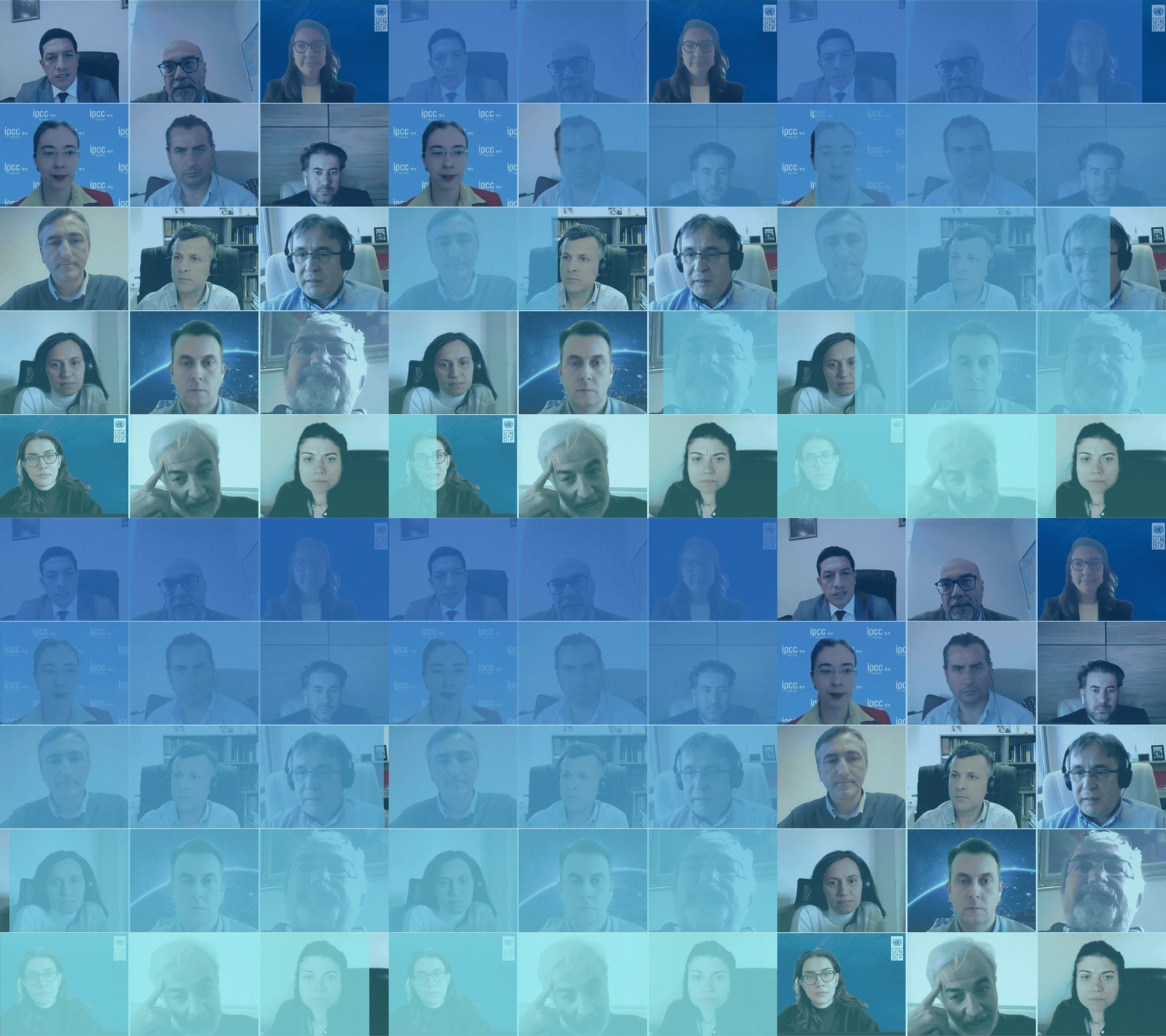
The meeting started with the opening speeches of Mr. Orhan Solak, Deputy Director of Climate Change, Ms. Meral Mungan Arda, Climate Change and Environment Portfolio Manager at UNDP Türkiye and Mr. Christian Ballarò, Program Officer at the Delegation of the European Union to Türkiye. The progress made under the project and the importance of collaborations for local climate action were emphasized in the opening speeches. Subsequently, Ms. Ceren Özkan, Project Manager at UNDP Türkiye, presented an overview of the project. Detailed information about the project objectives, activities carried out so far and plans for the upcoming period were shared.
Presentations on climate projection studies, which were the main subject of the meeting, provided detailed information on the methods used in the project, the analysis processes and the findings obtained. Prof. Dr. Ömer Lütfi Şen, Climate Projections and Impact Assessment Expert of the Project, presented a general framework on the main approaches and modeling processes followed in climate projection studies. Prof. Dr. Tuğrul Yılmaz, one of the climate modeling experts of the project, presented the high-resolution optimistic and pessimistic scenario climate projections obtained by dynamic downscaling of the CMIP6-based MPI-ESM1-2-HR model. The projection results were assessed with temperature, precipitation and wind parameters over Türkiye. Prof. Dr. İsmail Yücel, another climate modeling expert, presented the bias-corrected MPI-ESM1-2-HR model results and the results obtained using ERA5-Land reanalysis data, focusing on temperature, precipitation and wind parameters over Türkiye.
Climate projection studies will continue with the running of EC-Earth3-Veg., HadGEM3, MRI-ESM2-0 global models. The climate projection results will provide a scientific basis for the sectoral vulnerability and risk analyses to be carried out at the level of 12 NUTS-1 regions within the scope of the project, in line with the risk approach set out in IPCC AR6. High-resolution climate projections will be used for a more sensitive assessment of hazard, one of the main components of risk. Thus, the aim is to analyze the impacts of climate change at the local level with more comprehensive and locally specific up-to-date data.
Technical Advisory Committee meetings will continue to be regularly organized under the project. These meetings will provide project stakeholders with up-to-date information on the technical studies being carried out, while contributing to the participatory and effective implementation of the project with the opinions of experts in their fields.